- Inspiration
- Guides
- How to Use Candles Safely
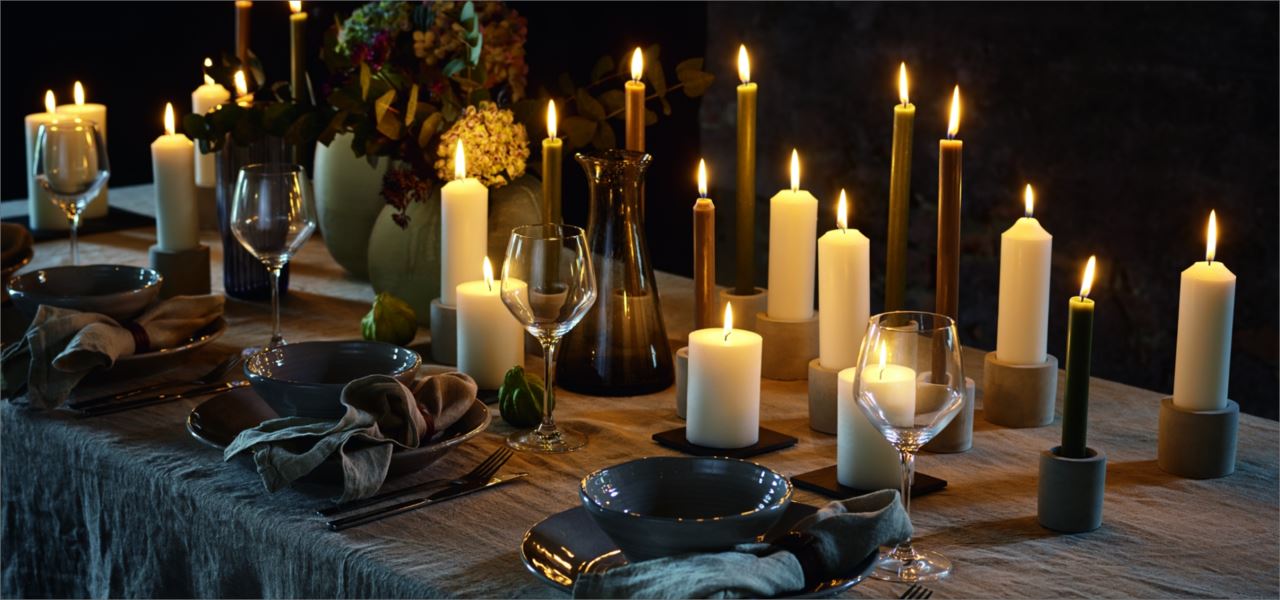
How to Use Candles Safely
Stearin Candles
Our 100% stearin candles are certified with the Nordic Swan Ecolabel and come with several benefits. They’re made exclusively from renewable resources and contain no soy, paraffin, or palm oil.
Stearin candles produce minimal dripping and soot, making them especially suitable for a healthy indoor environment. With a high melting point, they’re more heat-resistant than paraffin candles and retain their shape even in sunlight. This makes them perfect for outdoor use.
Thanks to their thick wick, our stearin candles burn with a steady, full flame.
Paraffin Candles
Paraffin candles are made from paraffin wax, a by-product of crude oil. They deliver a beautiful, even light and have a long burn time with minimal dripping when used under optimal conditions.
Since paraffin is a softer material, these candles are impact-resistant and keep their shape even with small knocks. However, they are more sensitive to direct sunlight and heat, so we recommend using them indoors only.
Candle Safety Tips
- Never leave burning candles unattended.
- Keep a safe distance from flammable materials.
- Store candles out of reach of children and pets.
- Always place candles on a flat, fireproof surface.
- Maintain at least 10 cm of space between each candle.
- Avoid placing candles near heat sources.
- Trim the wick to no more than 1 cm before lighting.
- Keep candles free of debris such as matchstick remnants.
- Always use a candle snuffer.
- Never move a burning candle.
- Ensure there is good airflow around the flame.
- Extinguish the flame when 1–2 cm of wax remains.
Reducing Soot
A small amount of soot is unavoidable when burning organic materials, especially when extinguishing the flame as this is when most particles are released.
To minimise this, we recommend using a candle snuffer or wick dipper. According to the Nordic Swan Ecolabel, a wick dipper can reduce soot particles by up to 90%.
And for the best indoor air quality: remember to air out the room after extinguishing your candles.
Tapered Candles
Taper candles are easy to light and extinguish, even if only burned briefly. They typically burn with an open flame and are fairly resistant to draughts. Still, it’s best to place them in sheltered spots to avoid flickering and soot.
Make sure to use a stable, heat-resistant holder so the candle burns evenly without dripping or tilting.
Pro tip: Trim the wick before lighting and always extinguish the candle before it burns all the way down; if the flame continues in the holder, it can overheat and potentially cause a fire.
Pillar Candles
Large lanterns are great for pillar candles. However, remeber to only use one candle per lantern to prevent heat build-up. If a candle gets too hot, it can become unstable and collapse. Keep at least 2 cm of space between the candle and the glass.
To avoid a high wax rim, pillar candles should burn for 4 to 6 hours at a time, especially the first time. If a tall rim does form, trim it carefully down to 0.5–1 cm above the melted wax. A high rim traps heat, which can cause overflow or increased soot.
Also important: keep an eye on wick length. If it becomes too long or curls downward, it can cause overheating.
Tealights
All candles need enough air, but tealights in particular develop a lot of heat. So make sure to use well-ventilated holders. Tealights come in transparent plastic or aluminium cups, and those with plastic need significantly more airflow.
Avoid using them in metal-coated holders, which intensify heat. Glass or ceramic holders are the better choice.
If a tealight gets too hot, the wick can tip to one side, and in rare cases, the cup itself can melt. Always make sure the wick stays centred.
If you re-light a tealight multiple times, its burn time can shorten. This increases the chance that the wick burns unevenly, preventing even wax melting.